


Why Construction-Themed Kids Events Are Winning Over Young Families

Give a child a pile of cardboard tubes, a bucket of blocks, a toy hard hat, and a problem to solve, and something clicks. The room gets louder, the ideas get bigger, and children who met five minutes ago start negotiating where the “bridge” should go.
That simple magic explains why construction-themed community events for kids have become such a strong draw for young families. They combine open-ended play, hands-on learning, and the kind of relaxed social setting parents often hope to find but rarely get from a typical weekend outing.
These events can take many forms. Some are “Touch-a-Truck” days with dump trucks, loaders, and fire engines parked for children to explore. Others are maker-style building sessions at libraries, children’s museums, recreation centers, hardware stores, or school gyms. Some focus on cardboard cities, modular blocks, wooden kits, sand tables, LEGO challenges, or simple engineering games.
What they share is a clear promise: children get to build, test, imagine, and work together, while families connect around a shared experience.

Kids love building because it gives their ideas a shape
Construction play works because it turns imagination into something children can touch. A pretend bakery becomes a cardboard storefront. A pile of blocks becomes a tunnel. A ramp becomes an experiment in speed, balance, and gravity.
Unlike many structured activities, building does not have one correct answer. That freedom matters. A child can make a crane that looks nothing like a real crane and still feel proud of the design. Another child may spend twenty minutes lining up traffic cones and calling it a work zone. Both are participating in meaningful play.
Strong construction-themed events usually include a mix of activity types, such as:
Big builds
Children work together on large cardboard structures, block towers, blanket forts, or foam-brick cities.
Small builds
Kids make take-home projects with craft sticks, recycled materials, snap-together kits, or interlocking bricks.
Problem-solving stations
Simple challenges ask children to build the tallest tower, the strongest bridge, or the longest marble run.
Pretend play zones
Hard hats, safety vests, toy tools, cones, and signs help children act out roles and stories.
Vehicle exploration
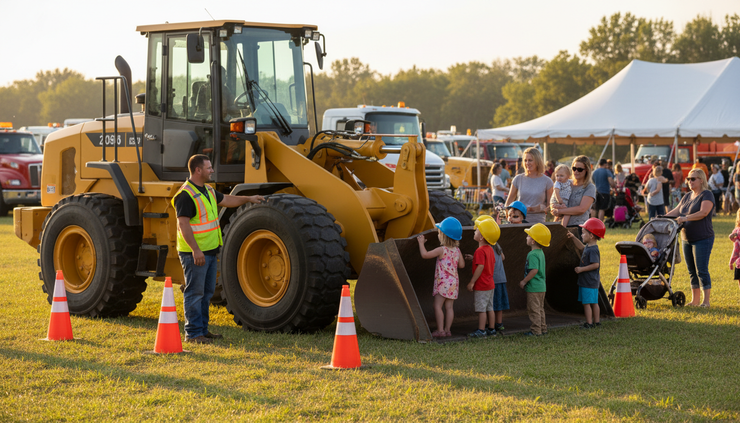
Parked construction vehicles, when safely managed, give children a rare chance to see machines up close.
The best activities allow children to move between solo focus and group work. One child may quietly design a block garage. Nearby, three others may argue, revise, and rebuild a road system until the toy trucks can pass through.
That blend of creativity and teamwork is part of the appeal for parents. It feels refreshing to watch children cooperate without needing constant adult direction. They practice asking for materials, sharing space, solving small conflicts, and explaining their ideas. Those are social skills wrapped in play.
Parents get more than a way to fill Saturday morning
Young families often look for outings that meet several needs at once. The activity should interest the child, feel safe, fit a reasonable budget, and offer enough flexibility for different ages and attention spans. Construction-themed events check many of those boxes.
They also solve a quieter problem. Many parents want more chances to meet other families, but it can feel awkward to start conversations at playgrounds or school pickup. A building event gives people something natural to talk about.
A parent can ask, “How did they get that tower to stand?” or “Where did you find those wheels?” without forcing small talk. Children also make introductions easier. When two kids start building the same road, adults often end up chatting beside them.
These events tend to feel low pressure. No one needs special clothes, advanced skills, or a long explanation of the rules. Families can drop into a station, stay as long as the child is engaged, then move on. That flexibility works well for toddlers, preschoolers, and early elementary children, especially when siblings have different energy levels.
A good family event does not just entertain children. It creates a setting where parents feel welcome, unhurried, and part of something local.
Construction play also appeals across interests. Some children love vehicles. Others love art, role play, sorting, stacking, or puzzles. A well-planned event can include all of those without feeling scattered.
For caregivers, the experience can be surprisingly relaxing. The materials are familiar, the goals are clear, and the activity is active enough to hold attention. Children are not just waiting in line for a ride or watching a show. They are making decisions.
Construction play quietly teaches engineering ideas
A child does not need to hear the word “engineering” to start thinking like an engineer. When a tower falls, the child adjusts the base. When a bridge sags, the child adds support. When a ramp is too steep, the child changes the angle and tests again.
That cycle of build, test, notice, and improve is the heart of many construction activities. It introduces STEM concepts in a way that feels natural rather than forced.
Common learning moments include:
Balance
Children discover that tall structures need wide or heavy bases.
Weight
They see that some materials can hold more than others.
Shape
Triangles, arches, columns, and beams become useful tools, not just vocabulary words.
Measurement
Kids compare height, length, distance, and speed through hands-on testing.
Planning
A shared build teaches children to sketch, sort materials, assign roles, and adjust plans.
Cause and effect
If the roof caves in, the group can ask why and try again.
These lessons are especially powerful because failure is built into the process. A collapsing block tower is not a disaster. It is information. Children can laugh, rebuild, and try a new idea.
That mindset helps families see learning in a broader way. Education does not always need worksheets or formal instruction. It can happen when a child notices that a paper tube works better as a column than a flat sheet of cardboard. It can happen when two children disagree about a bridge design and test both versions.
Many libraries and museums already use this approach. A children’s museum may host a “build a city” weekend with loose parts and taped roadways. A public library might set up an architecture challenge using blocks, craft sticks, and recycled boxes. Hardware stores have long offered kid-friendly building workshops where children assemble small wooden projects with adult help. These formats succeed because they make learning visible, social, and fun.
The goal is not to turn every child into a future builder or engineer. The goal is to help children ask better questions: What happens if we make it taller? Why did it tip over? How can we make room for everyone’s idea?
Successful events feel playful, safe, and easy to join
The most popular construction-themed events often share a few design choices. They are not complicated, but they are intentional.
Touch-a-Truck events work because they offer rare access. Most children see excavators, dump trucks, and cement mixers from a distance. At a community event, they can stand near the tire, look into the cab, and ask what the machine does. When organizers add quiet hours, clear walking paths, and patient equipment operators, the experience becomes more welcoming.
Hardware store kids workshops are another strong model. Children get a manageable project, basic tools, and a take-home result. The activity has enough structure to keep things moving, but enough hands-on work to feel real. Parents like that children leave with something they made.
Cardboard construction days are popular because they are affordable and flexible. A school gym, church hall, or recreation center can become a mini city with appliance boxes, packing tubes, masking tape, markers, and fabric scraps. Children can build houses, roads, tunnels, signs, and pretend shops. The setup invites repeat play, which means families often stay longer.
LEGO and block-building events also work well because the materials are familiar. Libraries often use building prompts to guide activity, such as “create a bridge for three toy animals” or “design a playground for your neighborhood.” These prompts encourage problem-solving without limiting creativity.

For an event to feel successful, organizers should think beyond the central activity. Families notice practical details:
Clear signs at the entrance
Stroller-friendly paths
Restrooms nearby
Seating for caregivers
Water access
Shade or indoor cooling
A calmer space for children who need a break
Age guidance for each activity
Volunteers who understand the flow
Safety matters most around tools and vehicles. Real equipment should be off, stationary, blocked off where needed, and supervised. Tool-based projects should use age-appropriate materials, eye protection when needed, and clear adult guidance. Even pretend construction zones benefit from simple rules, such as walk near the cones, keep blocks below shoulder height, and ask before taking materials from another build.
A smooth event does not need to be fancy. It needs to feel cared for.
These events help neighborhoods feel more connected
Construction-themed kids events are popular because they create more than a fun afternoon. They give communities a shared project, even if that project is a cardboard skyline that lasts only a few hours.
Families meet neighbors. Local builders, public works teams, firefighters, utility crews, librarians, teachers, and volunteers can show children what they do. Children see adults in their community as helpers, makers, and problem-solvers. Parents learn about programs they may not have known were nearby.
The theme also offers a natural bridge between generations. Grandparents can help tape cardboard walls. Teen volunteers can run a block challenge. Local tradespeople can explain tools in simple language. Younger children can contribute by decorating signs or sorting materials.
A shared building activity makes participation visible. Everyone can point to something and say, “We helped make that.” That feeling is powerful, especially in neighborhoods where families may live close together but rarely gather.
Community events also give children a chance to practice belonging. They learn that public spaces are places where they can contribute, not just behave. A child who paints a cardboard stop sign or helps create a block bridge has a small but real stake in the group effort.
That is one reason these events work well for city parks departments, libraries, schools, museums, neighborhood associations, and family-focused nonprofits. The construction theme is easy to understand, easy to scale, and easy to adapt for different budgets.
How to organize a construction-themed gathering families will remember
A strong event starts with one clear idea. It does not need ten attractions. One well-run building experience can be more memorable than a crowded schedule.
Start by choosing the main format:
Hands-on build day
Best for libraries, schools, and indoor community spaces. Use blocks, cardboard, recycled materials, craft sticks, tape, and simple prompts.
Workshop-style event
Best for smaller groups. Offer a guided project, such as a birdhouse, toolbox, mini bridge, or model neighborhood.
Vehicle exploration day
Best for large outdoor areas. Invite public works teams, local contractors, emergency services, or utility crews to display vehicles safely.
Mini construction festival
Best for bigger partnerships. Combine building stations, pretend play, story time, safety demos, and food vendors.
Next, plan for different ages. Toddlers need soft blocks, sorting bins, ride-on toys, and pretend tools. Preschoolers enjoy ramps, towers, costumes, and big cardboard pieces. Early elementary children can handle design challenges, simple measurements, and more detailed projects.
Keep instructions short. Instead of long rules, use simple prompts:
Build a bridge that can hold three toy trucks.
Make a tower taller than your knee.
Design a road that connects two neighborhoods.
Create a machine from recycled parts.
Work with another family to build one shared structure.
Materials do not need to be expensive. Many of the best supplies are easy to gather:
Cardboard boxes and tubes
Painter’s tape and masking tape
Foam blocks or cardboard bricks
Pool noodles cut into building pieces
Plastic cones and caution tape for pretend zones
Toy trucks and road mats
Craft sticks, clips, string, and rubber bands
Washable markers and stickers
Scrap fabric for roofs, flags, and signs
Recruit volunteers with clear roles. One person can welcome families. Another can refill materials. A few can supervise high-activity zones. Someone should watch for tripping hazards, sharp edges, and crowded areas.
If real vehicles are part of the event, create a safety plan early. Set traffic barriers, assign guides, and decide whether children can sit in cabs. Offer a horn-free quiet period if possible, since loud sounds can overwhelm younger children.

Promotion works best when it is specific. Tell families what children will actually do. “Build a cardboard city and explore a dump truck” is clearer than “family fun day.” Mention age range, parking, whether the event is free, and if registration is required.
Partnerships can make the event stronger. Local public works departments may bring vehicles. Hardware stores may donate wood scraps or kits. Libraries can add construction-themed story time. Scouts, high school clubs, trade programs, or parent groups can help run stations.
After the event, keep the community thread going. Share photos only with consent. Display children’s creations for a few days if the venue allows. Ask families what activity they want next time. A one-day build can become a seasonal tradition.
The real power is in making something together
Construction-themed kids events succeed because they turn ordinary materials into shared experiences. Children get to create, test, pretend, and collaborate. Parents get a welcoming place to meet other families. Communities get a simple way to bring people together across ages and backgrounds.
The theme is practical, but the feeling is bigger than trucks and tool belts. A child learns that ideas can become structures. A parent finds a new conversation. A neighbor lends a roll of tape. A volunteer helps a tower stand again.
That is why these events keep winning over young families. They offer the rare kind of play that is noisy, useful, social, and meaningful all at once. And with the right mix of safety, creativity, and local partnership, almost any community can build one.


I really like the idea of combining construction-themed activities with hands-on learning and teamwork. The vehicle exploration section is especially interesting because children can connect what they build with how real machines are used, while activities such as designing roads and solving building challenges encourage creativity and problem-solving. RC construction vehicles could be a great addition to this type of play, giving children another way to explore movement and different construction tasks. An RC Loader is a particularly fun example, as it can help bring the construction theme to life while keeping the activity interactive and imaginative.